Sample
Collect twenty representative inbound questions and their follow-ups.
Creator automation comparison
Both can reduce repetitive work, but they solve different inbox problems and require different levels of control.
A traditional chatbot waits for a keyword, button, comment, or predefined choice, then sends a stored response. It is easy to audit because each path is written in advance.
This works well for a small set of stable questions such as hours, a download link, or a menu of options. It becomes brittle when the fan asks a follow-up, uses unexpected wording, or combines two intents.
An AI DM assistant reads the current message and relevant thread, then prepares a response using an approved creator profile. It can handle varied wording and follow-ups without requiring a separate branch for every sentence.
That flexibility requires stronger controls. The assistant needs approved facts, destinations, voice guidance, uncertainty handling, and an explicit list of messages that return to the creator.
A chatbot can store several versions of the same template. An AI assistant can use sentence rhythm, preferred phrases, tone, and the current conversation to choose wording dynamically.
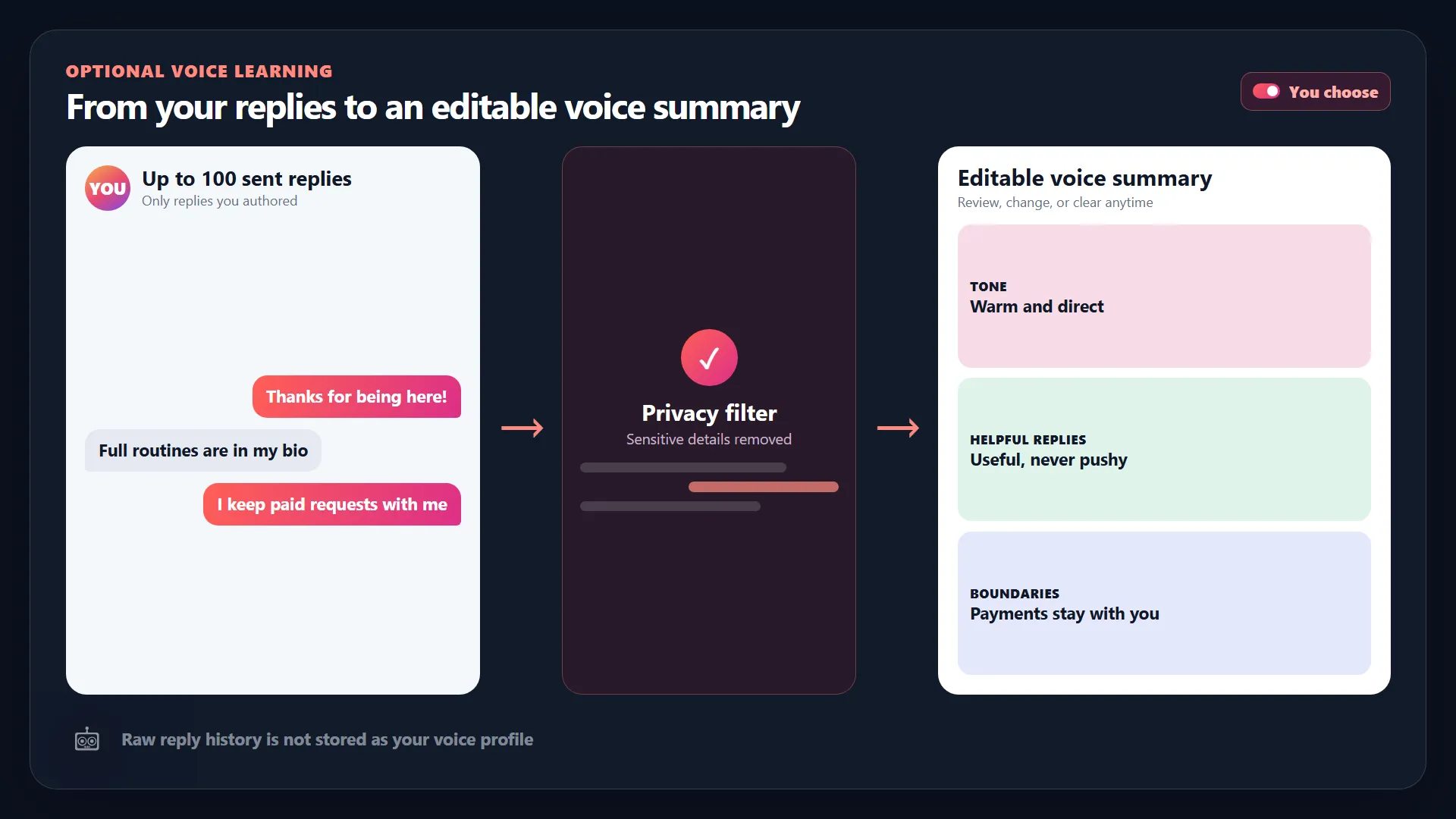
Loresta builds an editable voice profile from creator-provided details and, with consent, patterns from recent creator-authored replies. It does not need to claim that the automation is hidden or indistinguishable from a person.
A fixed flow usually hands off when no keyword or branch matches. A controlled AI assistant should also hand off when it detects a collaboration, payment issue, personal request, legal or safety concern, or low confidence.
The assistant should send nothing automatically in those cases and give the creator a useful alert. Read the handoff template examples.
Use fixed automation when questions and answers are exact, risk is low, and the path rarely changes. Use a DM assistant when inbound language varies, follow-ups matter, and creator voice is valuable.
Many creator inboxes benefit from both ideas: strict factual boundaries like a chatbot, with thread-aware natural language inside those boundaries. Loresta follows that narrower hybrid approach.
Controlled generation
Loresta lets the creator define voice, facts, destinations, and boundaries before the assistant prepares a reply.
Choose the least complex automation that can answer the real inbox safely.
Collect twenty representative inbound questions and their follow-ups.
Mark which can use an exact response and which require thread context.
Separate routine intent from owner-only conversations.
Use fixed paths, a controlled assistant, or a narrow combination.
Your answer depends on the variety and risk inside the inbox.
Direct answers for creators and operators comparing DM automation.
A chatbot usually follows fixed triggers and branches. An AI DM assistant interprets varied language and thread context, then generates within approved facts, voice, and handoff boundaries.
Fixed paths are easier to predict. A controlled AI assistant can still be safe when generation is limited by approved facts, narrow intents, low-confidence handoffs, and creator oversight.
Use one when the trigger and response are exact, follow-ups are rare, and there is little risk if the same stored answer is sent.
Yes. Templates can define factual structure and handoff behavior while AI adapts wording to the creator profile and current thread.
No. It focuses on routine inbound questions and returns personal, sensitive, business, payment, and uncertain conversations to the creator.
Loresta combines strict creator-approved boundaries with thread-aware replies for routine inbound questions.